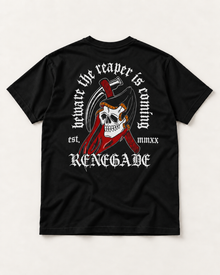
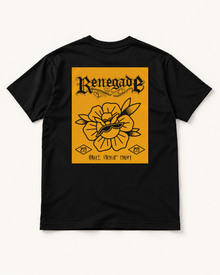
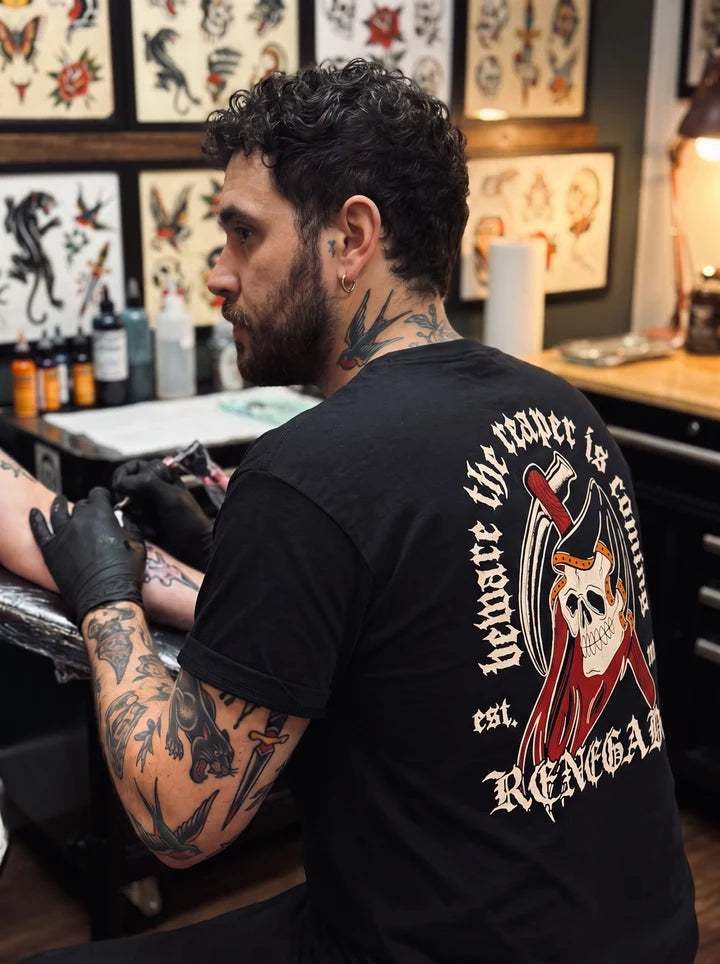
Halftone is a printing and image-reproduction technique, not a defining feature of traditional tattooing itself. It uses patterns of dots to create the appearance of lighter and darker tones when a process is working with limited ink values or spot colours.
How halftones work
Instead of printing every shade as a continuous gradient, a halftone breaks tonal areas into dots. Larger or more closely spaced dots read as darker; smaller or more widely spaced dots read as lighter. From normal viewing distance, the eye blends those dots into tone.
Why they appear in graphic clothing
Halftones are useful in screen printing and other graphic-production workflows because they can suggest depth without requiring a separate solid ink colour for every shade. That makes them a natural fit for bold illustration, posters, comics and tattoo-inspired apparel.
Halftone is not the same as tattoo shading
Traditional tattoo and flash artwork can use black shading, stippling, whip shading or pepper-style dot work, but those marks are drawn or tattooed as part of the artwork. A print halftone is a reproduction method applied when preparing or outputting an image. The two can look related, but they are not the same process.
What changes the look
Dot size, spacing, angle and screen frequency all affect how a halftone reads. Coarser dots feel more graphic and obvious; finer patterns can produce smoother tonal transitions but demand more from the print process and artwork preparation.
For the wider visual language, read What Is Tattoo Flash?. For production methods, see DTF vs Screen Print vs DTG.