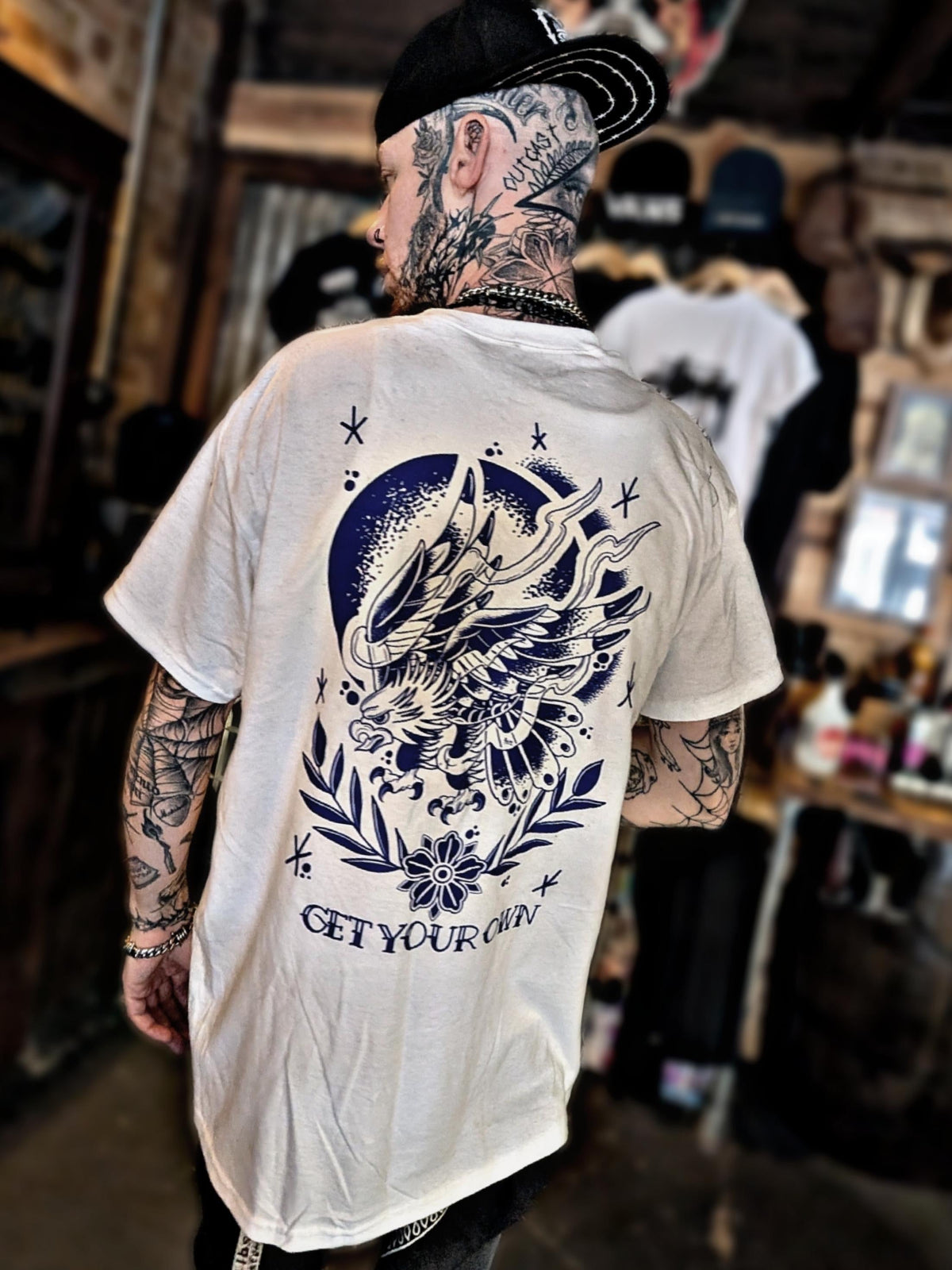
The eagle is one of the most recognisable subjects in traditional tattoo art. A hooked beak, spread wings and extended talons can create a complete image with very little wasted information, which is a big part of why the motif has survived generations of tattoo flash.
Like most traditional tattoo imagery, the eagle does not have one fixed meaning. Strength, freedom, courage and power are common associations, while American traditional examples have also appeared in patriotic and military contexts. The useful way to read the image is as a visual tradition with recurring associations, not a code where every eagle means exactly the same thing.
What does a traditional eagle tattoo mean?
Common readings include strength, freedom, courage and independence. In American imagery the bald eagle can also carry national or military associations, but that context should not be assumed automatically. A person may choose an eagle for personal symbolism, family history, visual impact or simply because the shape works brilliantly as a tattoo.
That distinction matters. Tattoo meanings are often presented online as if every historic design came with an official definition. In reality, artists, shops and wearers have reused the same motifs for different reasons over many decades.
Why does the eagle work so well in traditional tattooing?
The strongest traditional designs are readable quickly. Eagles naturally suit that approach because the main anatomy creates a clear hierarchy: head, wings, body and talons. Each part can be simplified without losing the subject.
A spread-wing eagle creates a broad triangular or diamond-shaped composition. A diving or side-facing eagle creates more directional movement. Feathers can be grouped into large shapes rather than rendered individually, while the beak, eye and talons provide small high-contrast focal points.
That combination gives the artist plenty of drama without requiring photorealistic detail.
The visual language of an old-school eagle
Traditional eagle artwork commonly relies on the same principles found across classic flash:
- Bold outer lines that keep the silhouette clear.
- Grouped feather shapes instead of hundreds of individual marks.
- Solid black to create weight and separate forms.
- A controlled palette rather than subtle gradients.
- Open negative space so wings, head and talons do not merge into one dark mass.
These are design principles rather than rigid rules. Different tattooers have always interpreted the eagle differently, but clarity is what makes the best versions immediately recognisable.
Spread wings, diving eagles and other compositions
The pose changes the feel of the design. A frontal eagle with wings spread can feel balanced and emblematic. A diving eagle creates more aggression and movement. A side-facing bird can fit long areas more naturally.
Traditional flash often exaggerates anatomy to improve the composition. Wings may open wider, talons may appear larger and the head may turn more sharply than it would in a natural-history illustration. The goal is not zoological realism; it is a strong graphic image.
Eagles in flash, prints and clothing
The same features that make an eagle readable on skin also make it effective in print. Strong wings create a clear silhouette from a distance, and the artwork can survive being reduced or enlarged without depending on micro-detail.
Our Old School Eagle Graphic Tee uses that approach as a front-and-back garment graphic, while the Old School Eagle Decal shows how the same kind of bold subject can work at a much smaller scale.
How the eagle fits into traditional tattoo flash
Eagles sit naturally beside roses, daggers, snakes, panthers, ships and other traditional motifs because the visual grammar is shared even when the subject changes: strong silhouettes, controlled detail, deliberate black and enough empty space for every part to breathe.
If you want the wider context, read What Is Tattoo Flash? and our guide to traditional tattoo motifs and their meanings.
For physical artwork, browse the Tattoo Flash Prints. For clothing built around the same graphic principles, see the Tattoo Graphic Tees.