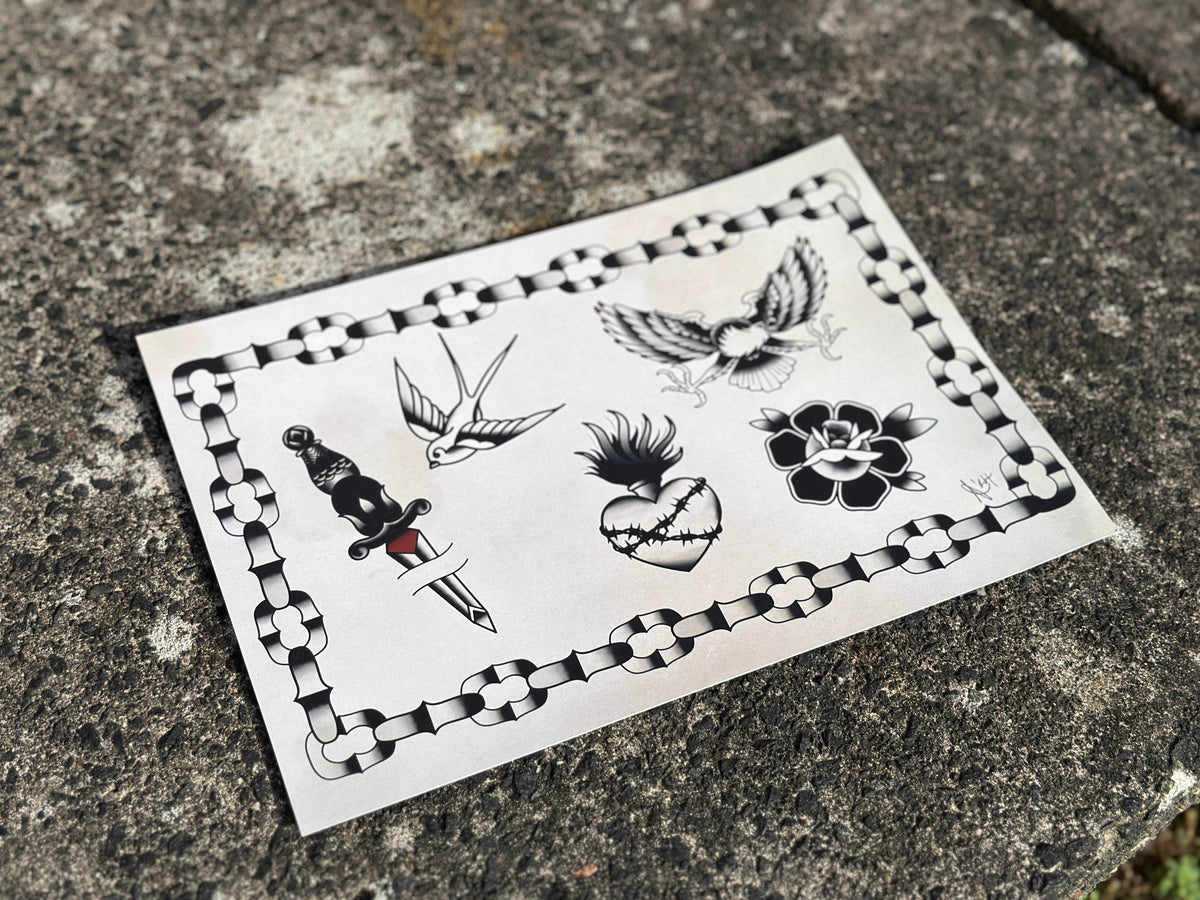
If you have spent any time around tattoo studios, old flash books or traditional tattoo artwork, you have probably seen a flash sheet: a group of ready-drawn tattoo designs arranged together on one page. Eagles, panthers, roses, daggers, hearts, reapers and other bold subjects are often presented as individual pieces that can be read quickly from across the room.
Flash is more than a collection of tattoo ideas. At its best, it is a lesson in graphic design: strong silhouettes, controlled detail, clear hierarchy and artwork that still reads when it is reduced in size. Those same qualities are a big part of why traditional tattoo imagery translates so naturally to prints and clothing.
What is tattoo flash?
Tattoo flash is pre-drawn tattoo artwork that gives a client a design to choose from rather than beginning every tattoo with a completely new drawing. A flash sheet groups several of those designs together so they can be viewed as a set.
The idea is practical. A customer can see the finished concept before choosing it, while the tattooer has already worked out the main composition, linework and shapes. Flash can be drawn as a one-off sheet, as part of a larger collection, or as repeated studio reference artwork.
Today, the term is also used more broadly for artwork made in the visual language of tattoo flash, even when the final piece is intended for a print, poster or garment rather than skin.
What makes traditional tattoo flash recognisable?
There is no single formula that every traditional tattoo artist follows, but classic flash tends to share a few visual principles.
- Bold outlines. Strong outer lines separate the subject clearly from the background and make the design readable at a glance.
- Simple, decisive shapes. The main silhouette usually does more work than tiny surface detail.
- Controlled colour. Traditional work often relies on a relatively compact palette rather than dozens of closely related tones.
- Black used with purpose. Solid black and strong shading give the design weight, contrast and structure.
- Negative space. Open areas stop the drawing becoming visually clogged and help individual forms remain clear.
- A strong central subject. An eagle should read as an eagle immediately; the same applies to a panther, rose, dagger or skull.
That clarity is why good flash often looks deceptively simple. Removing unnecessary information usually makes the important information stronger.
Why are flash sheets arranged as multiple designs?
A sheet lets several ideas sit together while still working as separate pieces. Good sheets have rhythm: large and small subjects balance each other, shapes point in different directions, and empty space keeps the page from feeling crowded.
The individual drawings do not need to form one big scene. The connection comes from consistent line weight, colour, shading and visual language. That is why a sheet containing an eagle, a rose and a dagger can still feel cohesive even though the subjects are unrelated.
Our Traditional Tattoo Flash Sheet Print uses that approach: separate classic motifs are treated as a single collection while each design still has enough space to stand on its own.
Common subjects in traditional tattoo flash
Traditional flash has built up a recognisable visual vocabulary over generations. Some subjects return again and again because their shapes are instantly identifiable and work well with bold linework.
Eagles
Spread wings, hooked beaks and strong feather shapes give eagles an immediate silhouette. They are particularly effective when the design needs movement without relying on lots of small detail. Our Old School Eagle Graphic Tee takes that kind of bold, readable composition and scales it for a garment.
Panthers
Panther heads and crawling panthers use sweeping curves, open mouths and large areas of black to create an aggressive, compact shape. That combination makes them one of the clearest examples of traditional tattoo design working through silhouette first.
Roses
Roses can be simplified into overlapping petals, leaves and a strong outer shape without losing their identity. If you want to go deeper into that subject, we have a separate guide to the rose in tattoo art.
Daggers, hearts and reapers
These subjects work because they have obvious focal points and directional shapes. A dagger creates a strong vertical line; a heart gives a simple central mass; a reaper can combine a readable figure, scythe and cloak into a compact composition. The Reaper Graphic Tee is our clothing example of that traditional-flash approach.
Traditional flash versus custom tattoo artwork
The main difference is not that one is more creative than the other. It is the starting point.
Flash begins with an existing design that has already been composed. Custom work begins with a new brief and is developed specifically for the client. Artists can still redraw, resize or adapt flash depending on how they work, and custom tattoos can use exactly the same traditional visual principles.
For a deeper look at one of the figures most closely associated with American traditional tattooing, see our guide to Sailor Jerry and American traditional tattoo art.
Why tattoo flash works so well on graphic clothing
A T-shirt and a tattoo are obviously different surfaces, but they share one important problem: the artwork has to read at a real-world viewing distance.
A graphic tee is rarely studied from ten centimetres away. The main subject needs to make sense while somebody is moving, while fabric is folding and from several feet away. Bold tattoo-flash composition is well suited to that job.
When adapting the principles to apparel, we look for the same fundamentals: a clear silhouette, enough contrast, deliberate negative space and details that survive at print size. The artwork then has to be adjusted for the garment itself — chest width, back-print scale, seams, folds and how the design sits on a person.
That is the connection between the art side of Original Renegade and the tattoo graphic tee range. We are not simply placing a picture of a tattoo on a shirt; we are using the graphic principles that make tattoo artwork effective and rebuilding them for print.
Where to start with tattoo flash
If you are new to the style, the easiest way to understand it is to look at the shapes before the subject matter. Ask whether the design still reads when you squint at it or view it small. Look at how much black is used, where the empty space sits and whether each element has a clear job.
For wall art, start with the Traditional Tattoo Flash Sheet Print. For clothing, the Old School Eagle and Reaper show two different ways those principles can be carried onto a T-shirt.
You can also browse our wider guide to tattoo-inspired clothing in the UK if you want to see how traditional flash, darker graphics and alternative streetwear overlap across the range.