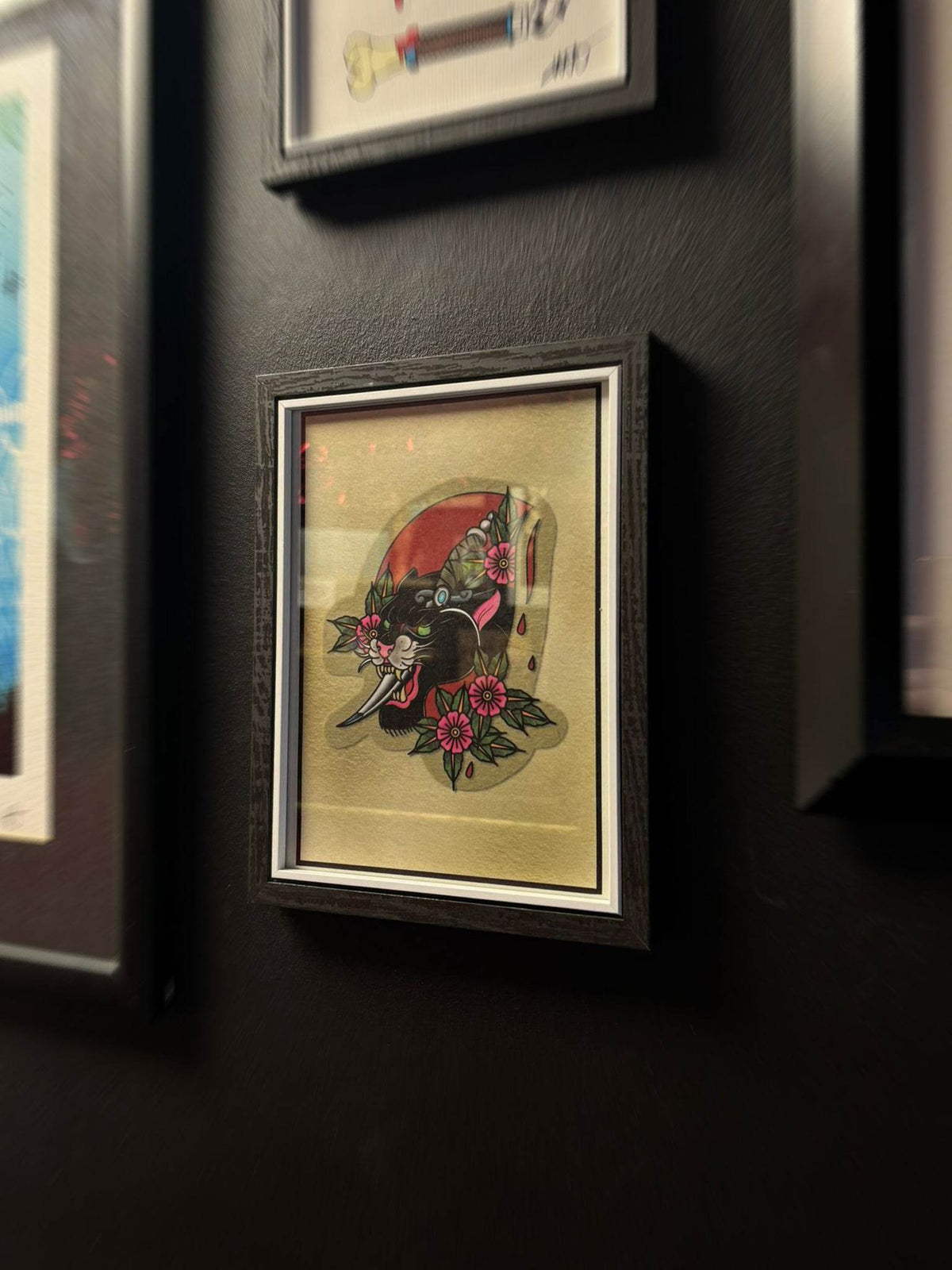
Few traditional tattoo motifs rely on silhouette as heavily as the panther. Whether it is a full crawling cat or a compact snarling head, the design can be recognised almost instantly through a curved back, open mouth, claws and large areas of solid black.
The panther has become one of the staple animals of traditional tattoo flash. Common associations include strength, ferocity, protection, courage and defiance, but—as with the eagle, rose or dagger—those meanings are not universal rules. The artist, wearer and surrounding imagery can change the reading completely.
What does a traditional panther tattoo mean?
Power and toughness are the most obvious associations because the image is usually shown in an active, confrontational pose. Protection, resilience and controlled aggression are also common modern readings.
It is better to treat those ideas as associations rather than fixed definitions. Traditional motifs were copied, traded, redrawn and adapted across shops for decades. A panther may carry personal meaning, or it may simply have been chosen because the image is visually strong.
Why the crawling panther became such a strong tattoo design
The classic crawling panther solves a practical composition problem. Its body can stretch along a diagonal, curve around a limb and create movement without needing a complicated background. The head, extended foreleg, spine and rear leg form a natural sequence that leads the eye through the design.
That makes the crawling pose adaptable. It can be lengthened, compressed or mirrored while still reading as the same basic motif.
The exact origin of the familiar crawling-panther pose is debated, but versions of the design became firmly established in twentieth-century traditional tattooing and were repeatedly redrawn by different artists. That process of repetition and variation is part of how flash develops: a successful composition survives because it works.
Why traditional panthers use so much black
Heavy black is not just decoration. It gives the panther its mass. A large dark body creates contrast against teeth, eyes, claws, mouth and any red or coloured accents. The result can remain readable even when the artwork is viewed from several feet away.
Historically, the dense dark shape also made panther designs useful when covering or disguising older tattoos. That practical quality helped reinforce a visual treatment that was already powerful on its own.
Panther head versus full crawling panther
A panther head concentrates the expression into a compact shape: eyes, teeth, nose, ears and heavy black around the face. It works well when the available space is limited.
A crawling panther uses the whole animal to create direction and tension. The long body and reaching claws make movement part of the design, so the image feels less like a badge and more like an action.
Neither is more authentic. They solve different compositional problems.
What makes a traditional panther read clearly?
The best versions usually depend on a few fundamentals:
- A decisive silhouette before internal detail is added.
- Large black masses balanced with open skin or paper.
- Clear facial focal points around the eye, mouth and teeth.
- Exaggerated claws and curvature that improve movement.
- Limited detail so the body does not become muddy.
Those same rules are why panther art works so well as flash and printed artwork.
Traditional panther artwork outside tattooing
The motif translates naturally to posters and clothing because it is built from bold graphic shapes rather than tiny realism. Our Traditional Panther Tattoo Flash Print uses the compact head approach, with heavy black and old-school linework designed to read clearly as wall art.
You can see the broader design language in our Tattoo Flash Prints collection and in the What Is Tattoo Flash? guide.
Panthers as part of the wider tattoo vocabulary
The panther often appears beside daggers, snakes, roses and other established subjects. Pairing motifs changes the composition and can also change how viewers interpret the piece. A panther head pierced by a dagger does not read exactly like a crawling panther on its own.
For a wider overview of those subjects, read Traditional Tattoo Motifs and Their Meanings. The important point is the same across all of them: traditional imagery is a visual language, not a fixed dictionary.